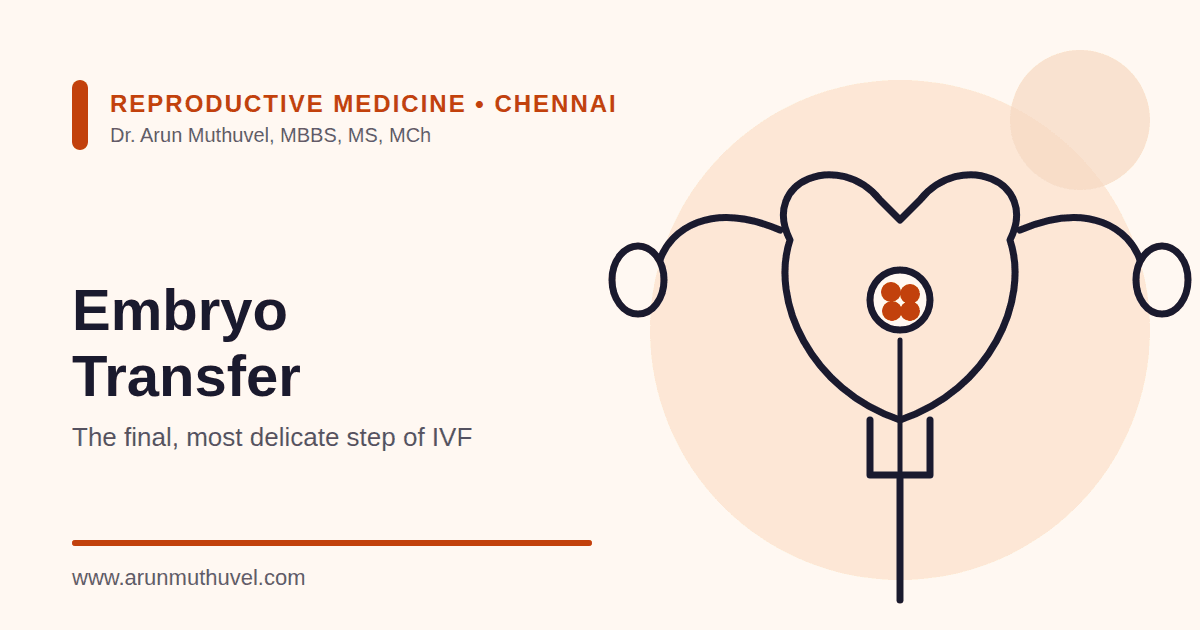
Embryo transfer is the final step of an IVF cycle, in which one or more embryos are placed into the uterus through a fine catheter. It takes only a few minutes and is usually painless, yet it is one of the most technique-sensitive steps in IVF. A difficult or traumatic transfer can undo weeks of careful stimulation and embryo culture.
This guide explains how the uterus is prepared, how embryos are selected, how the transfer is performed, and what patients can expect afterward.
Embryo transfer expertise with Dr. Arun Muthuvel in Chennai
Dr. Arun Muthuvel is an MCh-qualified reproductive medicine and surgery specialist in Chennai with particular attention to embryo transfer technique. His protocol includes a mock transfer or cavity assessment before the cycle, ultrasound-guided placement, soft catheters, gentle handling, and a strong preference for single embryo transfer of a well-selected embryo.
A best-practice transfer is atraumatic, quick, and precise. Blood on the catheter, use of a tenaculum, uterine contractions, and placement too close to the fundus are all associated with lower pregnancy rates. Dr. Arun Muthuvel’s approach is designed to avoid each of these, and each transfer is planned with the patient’s cavity anatomy known in advance.
Fresh Versus Frozen Embryo Transfer
In a fresh transfer, embryos are placed in the uterus three to five days after egg collection in the same cycle. In a frozen embryo transfer (FET), embryos are vitrified and transferred in a later cycle once the uterus has been prepared separately.
Frozen transfer is now used for the majority of cycles. It avoids the effects of high stimulation hormone levels on the lining, eliminates the risk of ovarian hyperstimulation worsening in pregnancy, allows time for genetic testing of embryos, and gives comparable or better outcomes in women who respond strongly to stimulation or have raised progesterone at trigger. Fresh transfer remains a good option for many normal responders with a receptive lining.
Day 3 or Blastocyst (Day 5) Transfer?
Embryos can be transferred at the cleavage stage (day 3) or after they have developed into blastocysts (day 5 or 6). Blastocyst transfer allows better selection because only embryos with genuine developmental potential reach this stage, and it permits single embryo transfer with high success. It also matches the natural timing at which an embryo enters the uterus.
When only one or two embryos are available, a day 3 transfer may be chosen to avoid the possibility of none surviving to day 5 in the laboratory. The decision is individual and made with the embryology team.
Preparing the Endometrium
For a frozen transfer, the lining is prepared either in a natural cycle, tracking the woman’s own ovulation and timing transfer accordingly, or in a hormone-replacement cycle using oestrogen followed by progesterone. Ultrasound confirms a trilaminar lining, usually 7 mm or more, before progesterone is started. The transfer day is then fixed by the number of days of progesterone exposure so that the embryo’s age matches the lining’s receptivity.
In women with repeated failure, additional assessment of the cavity by hysteroscopy, endometrial biopsy for chronic endometritis, or endometrial receptivity testing may be considered.
How the Embryo Transfer Procedure Is Performed
- Confirmation: the patient’s identity and the embryo details are double-checked with the embryologist.
- Full bladder: a moderately full bladder straightens the uterus and improves the ultrasound view.
- Speculum and cleaning: the cervix is visualised and mucus is gently removed from the cervical canal.
- Ultrasound guidance: abdominal ultrasound shows the catheter path in real time.
- Catheter placement: a soft outer sheath is advanced through the cervix, and the inner catheter carrying the embryo in a tiny drop of medium is passed to the upper-middle part of the cavity, about 1 to 2 cm from the fundus.
- Slow release: the embryo is expelled gently and the catheter is withdrawn after a brief pause.
- Catheter check: the embryologist confirms under the microscope that the embryo has been released.
The procedure takes 5 to 10 minutes and needs no anaesthesia. A mock transfer earlier in the cycle, or during a previous hysteroscopy, identifies the cervical direction and cavity length so that the real transfer is smooth.
How Many Embryos Should Be Transferred?
Elective single embryo transfer is the standard of care for good-quality blastocysts, especially in women under 38 and in all cases where embryos have been genetically tested. Twin pregnancies carry substantially higher risks of preterm birth, low birth weight, pre-eclampsia, and caesarean delivery. Transferring two embryos increases the chance of twins far more than it increases the chance of a baby. Dr. Arun Muthuvel advises single embryo transfer whenever embryo quality permits, and transfers two only after a careful discussion of risks.
After the Transfer: The Two-Week Wait
Bed rest is not required and prolonged rest may be slightly harmful. Patients can walk out of the clinic and resume normal daily activity the same day, avoiding only very strenuous exercise, heavy lifting, hot baths, and saunas. Progesterone support continues as prescribed. Mild cramping, spotting, or breast tenderness can occur and do not predict the outcome either way.
A blood pregnancy test is done about 9 to 12 days after a blastocyst transfer. Home urine tests before that date can be misleading because of the trigger injection or early low levels.
What Affects Embryo Transfer Success?
- Embryo quality and genetic normality, which depend largely on the woman’s age
- Endometrial receptivity and correct synchronisation with the embryo’s stage
- Transfer technique: ultrasound guidance, soft catheter, no blood or mucus, no cervical trauma
- Uterine factors: polyps, fibroids, adhesions, hydrosalpinx, or chronic endometritis
- Laboratory quality in culture, vitrification, and warming
- General health: thyroid function, weight, smoking, and control of medical conditions
Frequently Asked Questions
Is embryo transfer painful?
Most women feel only mild discomfort similar to a smear test. Anaesthesia is not needed. A very tight or angulated cervix is identified beforehand so that the transfer is planned appropriately.
Can the embryo fall out after transfer?
No. The embryo is placed in a closed cavity where the walls are in contact, and normal walking, urination, and daily activity do not dislodge it.
Should I rest after embryo transfer?
No special rest is needed. Studies show that immediate return to normal activity does not lower pregnancy rates, and strict bed rest offers no benefit.
Why consult Dr. Arun Muthuvel for embryo transfer in Chennai?
His attention to transfer technique, endometrial preparation, and single embryo transfer, combined with expertise in hysteroscopy for cavity problems, aims to give each embryo the best possible chance. Read more in our guide to IVF treatment in Chennai.
The Bottom Line
Embryo transfer is a short, simple-looking procedure whose details strongly influence IVF success. Dr. Arun Muthuvel provides best-practice embryo transfer in Chennai: ultrasound-guided, atraumatic, precisely timed to a prepared endometrium, and with a strong emphasis on healthy single embryo transfer.
This article provides general medical information and does not replace individual diagnosis or treatment advice. IVF outcomes vary with age, embryo quality, uterine factors, and clinical circumstances.