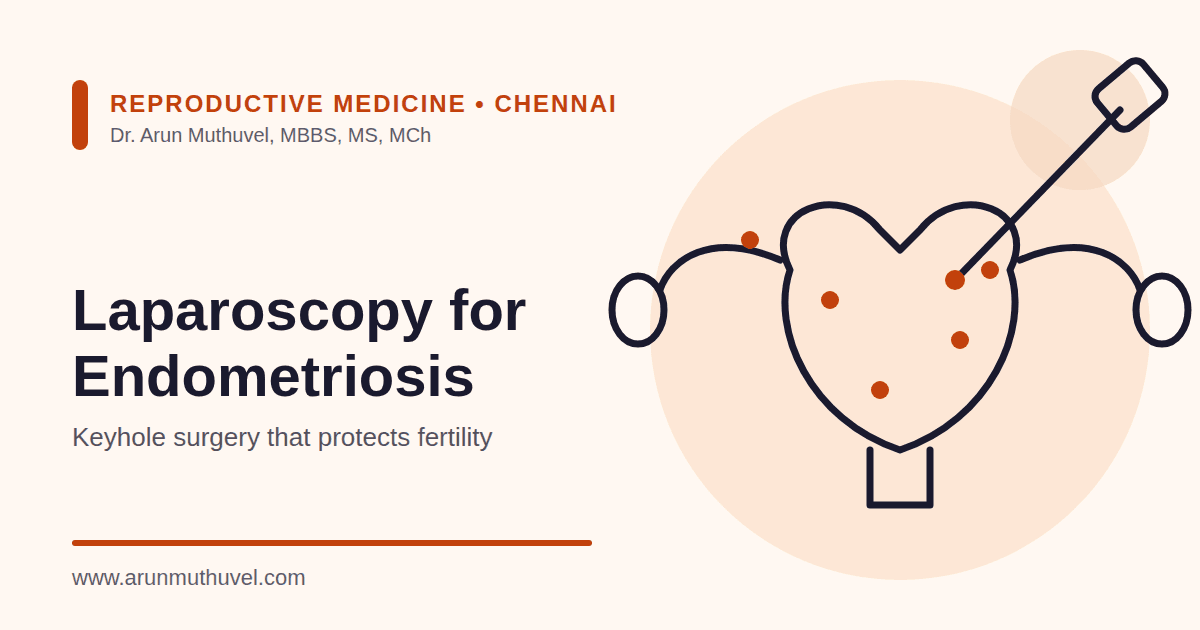
Endometriosis is a condition in which tissue similar to the lining of the uterus grows outside it, most often on the ovaries, fallopian tubes, pelvic peritoneum, and the space between the uterus and rectum. It can cause painful periods, pain during intercourse, chronic pelvic pain, and difficulty conceiving.
Laparoscopy is keyhole surgery performed through small incisions in the abdomen with a camera and fine instruments. For endometriosis it is both the most reliable way to confirm the diagnosis and the main surgical treatment. This guide explains when laparoscopy is worth considering, what the surgery involves, and how it is coordinated with fertility care. For an overview of the condition itself, read our guide to endometriosis causes, symptoms and fertility treatment.
Laparoscopic endometriosis surgery with Dr. Arun Muthuvel in Chennai
Dr. Arun Muthuvel is an MCh-qualified reproductive medicine and surgery specialist in Chennai with focused expertise in laparoscopic surgery for endometriosis. His approach treats surgery as one step in a fertility plan: the decision to operate, the extent of excision, the handling of ovarian cysts, and the timing of IVF are decided together rather than in isolation.
Endometriosis surgery in a woman who wants children is different from surgery for pain alone. The priority is to remove disease and restore anatomy while protecting ovarian reserve. Dr. Arun Muthuvel plans each laparoscopy around the patient’s age, AMH level, symptoms, and reproductive goals, and advises against operating when surgery is unlikely to add benefit.
Why Laparoscopy Is Used for Endometriosis
Ultrasound and MRI can detect endometriomas (ovarian endometriosis cysts) and deep nodules, but superficial peritoneal disease is often invisible on imaging. Laparoscopy allows direct visualisation of the pelvis, tissue sampling for histology, and treatment during the same procedure.
Compared with open surgery, laparoscopy offers smaller scars, less pain, a shorter hospital stay, faster return to normal activity, and better magnified views of small lesions. For these reasons it is the standard surgical approach for endometriosis worldwide.
Who Should Consider Laparoscopy?
Not every woman with endometriosis needs surgery. Laparoscopy is generally considered when:
- Pain does not respond to hormonal treatment and pain relief, or hormonal treatment is not suitable because pregnancy is desired
- An endometrioma is large, growing, causing symptoms, or has features that need histological confirmation
- Infertility is present with suspected or confirmed endometriosis, particularly in younger women with good ovarian reserve and no other major fertility factor
- Deep endometriosis affects the bowel, bladder, or ureter and causes obstruction or significant symptoms
- Diagnosis is uncertain and confirming it would change management
In women planning IVF, surgery is not always the first step. Removing a small, symptom-free endometrioma before IVF does not improve pregnancy rates and can reduce egg numbers. This is one of the most important judgements in endometriosis care.
Excision Versus Ablation
Endometriosis lesions can be treated by ablation (burning the surface with energy) or excision (cutting the lesion out completely). Excision provides tissue for histology, treats disease that extends beneath the surface, and is associated with better long-term pain outcomes, especially for deep lesions.
Dr. Arun Muthuvel favours careful excision of visible disease with restoration of normal pelvic anatomy, using minimal energy near the ovaries, tubes, ureters, and bowel to limit collateral damage.
Endometrioma Surgery and Ovarian Reserve
Endometriomas are cysts of endometriosis within the ovary. Surgical options include stripping the cyst wall (cystectomy) or draining and ablating the cyst lining. Cystectomy has lower recurrence, but healthy ovarian tissue can be lost with the cyst wall, which may reduce AMH and future egg numbers.
Techniques that protect ovarian reserve include identifying the correct plane between cyst and ovary, gentle traction rather than forceful stripping, targeted haemostasis instead of widespread coagulation, and avoiding surgery on small or recurrent cysts when it does not change the fertility plan. In women with low reserve or bilateral cysts, egg or embryo freezing before surgery may be discussed.
How Laparoscopy for Endometriosis Is Performed
- Pre-operative planning: symptoms, imaging, AMH, and fertility goals are reviewed; bowel or urinary involvement is mapped in advance so the right team and equipment are available.
- General anaesthesia: the procedure is performed while the patient is fully asleep.
- Port placement: a small incision at the navel admits the camera, and two or three additional 5 mm incisions admit the instruments. The abdomen is inflated with carbon dioxide gas to create working space.
- Systematic inspection: the uterus, ovaries, tubes, peritoneum, pouch of Douglas, bowel surface, and bladder are examined and the disease is staged.
- Treatment: adhesions are released, lesions are excised, endometriomas are removed, and, where appropriate, tubal patency is checked with dye.
- Closure: the gas is released and the small incisions are closed with fine sutures.
Recovery After Laparoscopy
Most patients go home the same day or the following morning. Shoulder-tip pain from the gas, mild abdominal soreness, and tiredness are common for a few days. Light activity can usually be resumed within a week and most women return to work within one to two weeks, depending on the extent of surgery.
Seek review for fever, worsening abdominal pain, heavy bleeding, persistent vomiting, difficulty passing urine, or redness and discharge at the incision sites.
Fertility After Endometriosis Surgery
In women with minimal or mild endometriosis, laparoscopic treatment modestly increases the chance of natural conception. In moderate and severe disease, surgery can restore anatomy and relieve pain, but the chance of spontaneous pregnancy depends on age, ovarian reserve, tubal status, and the male partner.
The months after surgery are often the best window for conception. Dr. Arun Muthuvel discusses a clear plan before the operation: trying naturally, ovulation induction with IUI, or proceeding to IVF treatment in Chennai without delay when age or reserve is a concern.
Risks and Limitations
- Bleeding, infection, or wound problems
- Injury to the bowel, bladder, ureter, or blood vessels, more likely with deep disease and adhesions
- Reduction in ovarian reserve after endometrioma surgery
- Recurrence of endometriosis or symptoms over time
- Conversion to open surgery in rare situations
- Risks related to general anaesthesia
Frequently Asked Questions
Will laparoscopy cure endometriosis?
Surgery removes visible disease but does not cure the underlying tendency. Symptom recurrence over five years is common. Hormonal suppression after surgery, or pregnancy, reduces recurrence in women not trying to conceive immediately.
Should I have surgery before IVF?
Usually only when there is significant pain, a large or suspicious cyst, hydrosalpinx, or difficult access to the ovaries for egg collection. Otherwise IVF can proceed without surgery, and the decision is individual.
How soon can I try to conceive after surgery?
Most women can try from the next cycle unless advised otherwise. Timing depends on the extent of surgery and whether hormonal treatment has been prescribed.
Why consult Dr. Arun Muthuvel for endometriosis laparoscopy in Chennai?
His training combines advanced laparoscopic surgery with reproductive medicine, so the operation is planned to protect ovarian reserve and to fit the couple’s fertility timeline rather than being treated as a separate procedure.
The Bottom Line
Laparoscopy is the definitive way to diagnose and surgically treat endometriosis, offering pain relief and, in selected women, improved fertility. Dr. Arun Muthuvel provides expert laparoscopic endometriosis surgery in Chennai with a fertility-first approach that balances complete treatment against protection of ovarian reserve.
This article provides general medical information and does not replace individual diagnosis, consent, or surgical advice. Outcomes vary with disease stage, age, ovarian reserve, and clinical circumstances.