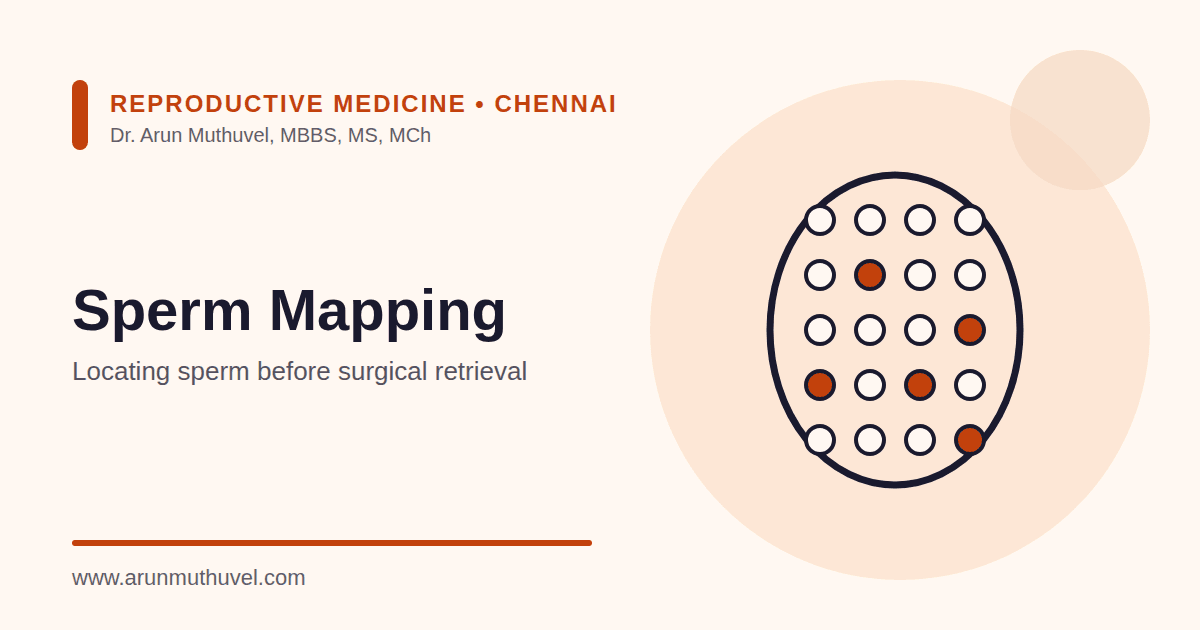
Sperm mapping is a minimally invasive diagnostic technique in which multiple fine-needle aspirations are taken systematically from different areas of each testicle and examined for sperm. The result is a map showing where sperm production exists, which helps predict whether surgical sperm retrieval will succeed and where to direct it.
In non-obstructive azoospermia, sperm production is often patchy: a few areas may contain sperm while most of the testicle does not. Sperm mapping was developed to find these areas before surgery. This guide explains how it works, who benefits, and how it fits with micro-TESE.
Sperm mapping expertise with Dr. Arun Muthuvel in Chennai
Dr. Arun Muthuvel is an MCh-qualified reproductive medicine and surgery specialist in Chennai with focused expertise in sperm mapping and surgical sperm retrieval for azoospermia. He uses fine-needle aspiration mapping as a targeted diagnostic step in selected men, interpreting the map alongside hormone levels, genetics, and testicular examination to plan the most appropriate retrieval procedure.
Sperm mapping is a tool, not a treatment. Its value lies in selecting the right man for the right procedure: guiding micro-TESE toward productive areas, avoiding unnecessary surgery when no sperm are found anywhere, and identifying men in whom a simpler needle retrieval may suffice. Dr. Arun Muthuvel explains the map’s limitations as clearly as its findings.
How Sperm Mapping Works
Under local anaesthesia, a very fine needle is passed through the scrotal skin into the testicle at a series of predetermined points, typically 6 to 18 sites per testicle depending on testicular size. A tiny sample of cells is drawn from each site, smeared on a slide, stained, and examined for sperm. Each site is recorded as positive or negative, producing a map of sperm distribution.
Because the needle is fine and no incision is made, tissue damage is minimal and the procedure can be repeated or followed by open surgery without significant scarring. Mapping is done as a separate procedure, usually weeks before any planned retrieval, so the result can inform the surgical plan.
Who Benefits From Sperm Mapping?
- Non-obstructive azoospermia with uncertain chance of retrieval, especially small testes or high FSH
- Previous failed TESE or micro-TESE, to determine whether another attempt is worthwhile and where to look
- Men wishing to know the likelihood of success before committing the female partner to IVF stimulation
- Selected genetic conditions such as Klinefelter syndrome, where mapping can guide expectations
- Deciding between retrieval methods: a map with several positive sites may allow a targeted needle or limited open retrieval; a sparse map points to micro-TESE
Men with obstructive azoospermia do not need mapping, because sperm production is normal throughout and a simple aspiration will find sperm.
Evaluation Before Sperm Mapping
- Confirmed azoospermia on two centrifuged semen samples
- Examination of testicular volume and consistency, epididymis, and vas deferens
- FSH, LH, testosterone, and prolactin
- Karyotype and Y-chromosome microdeletion testing; men with complete AZFa or AZFb deletions have no realistic chance of retrieval and are counselled rather than mapped
- Review of previous surgery and pathology reports
- Assessment of the female partner so the eventual retrieval can be aligned with IVF-ICSI
How Sperm Mapping Is Performed
- Anaesthesia: a spermatic cord block and local infiltration of the scrotal skin; sedation can be added for comfort.
- Marking: the sites are marked on the scrotal skin over each testicle in a grid pattern.
- Aspiration: at each site a fine needle attached to a syringe is inserted and moved gently to collect cells, then withdrawn.
- Slide preparation: each aspirate is smeared on a labelled slide and fixed.
- Examination: the slides are stained and read for the presence and number of sperm at each site.
- Reporting: a map records positive and negative sites for each testicle.
The procedure takes about 30 to 45 minutes and is done as a day-care procedure. Results are available within a few days.
Interpreting the Map
| Map result | Interpretation | Usual next step |
|---|---|---|
| Sperm at most sites | Widespread production, likely obstruction or mild impairment | Needle or limited open retrieval timed with IVF-ICSI |
| Sperm at a few sites only | Focal production typical of non-obstructive azoospermia | Micro-TESE directed to the positive areas |
| Sperm on one side only | Asymmetric production | Retrieval focused on the productive testicle |
| No sperm at any site | Low but not zero chance of retrieval | Counselling; micro-TESE may still be considered in selected men, or donor sperm discussed |
A negative map does not completely exclude sperm, because micro-TESE examines far more tissue than a needle can sample. Conversely, a positive map strongly predicts success at surgery.
Sperm Mapping and Micro-TESE
Mapping and micro-TESE are complementary. Mapping provides advance information with minimal tissue disturbance; micro-TESE provides the most thorough search under magnification on the day of retrieval. In men with a positive map, surgery can be shorter and more targeted, removing less tissue. In men with a negative map, the couple can make an informed decision about whether to proceed. Read more about micro-TESE for non-obstructive azoospermia.
Recovery, Risks and Limitations
Discomfort after mapping is mild and settles within a day or two with scrotal support and simple pain relief. Bruising is common; haematoma and infection are uncommon. Because no incision is made, return to normal activity is quick.
- Sampling error: a fine needle samples a small fraction of the testicle
- Mapping is diagnostic only; sperm found on the slides are fixed and cannot be used for ICSI
- A separate retrieval procedure is still required, adding a step and a cost
- Interpretation requires an experienced cytology reader
- Evidence base is smaller than for micro-TESE, and not all centres use mapping
Frequently Asked Questions
Is sperm mapping painful?
The cord block and local anaesthetic make the procedure well tolerated. Most men describe pressure rather than pain, with mild aching afterward.
Can sperm found during mapping be used for IVF?
No. Mapping samples are stained for diagnosis. A separate retrieval, planned according to the map, obtains live sperm for ICSI or freezing.
How accurate is sperm mapping?
When sperm are found on the map, retrieval succeeds at surgery in the great majority of men. When none are found, some men still have sperm retrievable by micro-TESE, so the result is discussed as a probability rather than a verdict.
Why consult Dr. Arun Muthuvel for sperm mapping in Chennai?
His expertise in azoospermia evaluation, sperm mapping, micro-TESE, and IVF-ICSI planning allows the map to be used purposefully: to choose the right procedure, target it precisely, and spare the couple unnecessary surgery. See also azoospermia treatment in Chennai.
The Bottom Line
Sperm mapping locates sperm production within the testicles of men with non-obstructive azoospermia, helping predict and direct surgical sperm retrieval. Dr. Arun Muthuvel offers expert sperm mapping in Chennai as part of a complete azoospermia service that includes micro-TESE and IVF-ICSI coordination.
This article provides general medical information and does not replace individual diagnosis, consent, or surgical advice. Sperm-retrieval and IVF outcomes vary with the underlying diagnosis and clinical circumstances.